I have a confession to make. For the last six months, I have been using food stamps. It’s easy, and I like it. I get $200 added to a little blue card every month, which I use like a debit card at any convenience store, supermarket, health food store, Asian market, or even farmer’s market within the state of Oregon that I please. Basically, I eat for free, so long as I don’t want to go to a restaurant or the hot food bar at the grocery store.
This might not seem like much of a confession. After all, about 20% of Oregon residents receive food benefits, and along with unemployment checks and the occasional visit to the food bank, it’s how a lot of Americans are scraping by these days. I took an Americorps job in June, and under this government-funded program, participation in SNAP (Supplemental Nutrition Assistance Program, the title that has replaced the phrase “food stamps” in government-speak) is all but expected. With my initial paperwork, I was given a letter addressed to the local branch of the Department of Human Services, which administers food benefits. To paraphrase, it said “Tuula works for Americorps now. We don’t actually pay her a living wage. Sign her up for food stamps, stat.” Everyone I worked with got the same form, and one-by-one, we trudged down to the DHS office, answered a couple of basic questions about our living expenses, and were handed the magical blue cards.
I remember sitting in my car in the parking lot outside the building, trying to adjust my frame of mind enough to allow myself to go in. Like a lot of people in this country, especially those with immigrant families who lived out some version of the American Dream, I considered accepting any form of federal welfare to be right down there with begging on the street corner. As I sat watching the rain dripping down my windshield, contemplating the course of my life, I started feeling very sorry for myself. Don’t I have a college degree? I wondered. How did I get here? What have I done wrong? Then I remembered: I wanted this. I wanted to do the low-paying, environmental, non-profit, social-service work. It makes me feel good. Besides, the economy is falling apart. I’m lucky to have a job of any kind, and it’s not like I’ll be a welfare bum forever. I pulled my jacket hood over my head, grabbed my letter, and went out into the rain.
That was six months ago. My Americorps term of service up, but I’m still on SNAP as I job search and try to avoid moving in with my parents. As difficult as it was to take the dink to my pride, I’m glad I did it. Not only did having my food bill taken care of allow me to save money while earning less than minimum wage from Americorps (another valuable experience), it also gave me some insights into the economics and geography of how we eat.
Because the SNAP card works exactly like a debit card would, it took me a while to notice any changes in my food buying habits. In fact, using EBT is quite discrete – at the store, they ring up your groceries, you swipe your card, selecting “EBT” instead of “debit/credit”, enter your PIN, take your receipt (which gives you the balance left for that month) and you’re on your way. As someone with a lot of initial guilt and shame surrounding the use of food stamps, I was grateful for this hassle-free process. I didn’t stand out.
That was the grocery store. The farmers market was a different story. After I found out that I could use my EBT card at the Lane County Farmers Market (for some reason, they don’t really advertise this feature), I took the next beautiful Saturday afternoon to stroll downtown with my grocery bag and pick out some fresh, organic veggies. I met my friend Tara, a fellow Americorps member, there. First, we had to visit a little booth, crammed between tables overflowing with produce, where a woman ran $10 off the balance of our cards (they do it in $5 increments) and gave us each ten wooden tokens that she said could be exchanged dollar-for-dollar at any of the farmer’s stands. Unfortunately, she told us, we couldn’t receive change in cash, so if we bought something for 50 cents, we would have to hand over a whole token. We started elbowing our way through the market throngs, and I found some carrots and a basket of strawberries, handed over five tokens, and didn’t get hassled. Tara, on the other hand, just wanted strawberries, and went to a different farmer for them. When she tried to pay, though, the woman behind the table frowned.
“Can you pay with something else?” she asked. “We get charged a fee to exchange those.” In the busy scuffle of the market, Tara didn’t feel like putting up a fight and holding up the line, so we dug through our pockets to produce some change. The woman didn’t seem much happier about the pile of nickles, dimes and quarters she provided, but what did she expect? As Tara pointed out on the walk home, if we had the option to pay some other way, we wouldn’t be on food stamps.
The more I thought about it, the more it irritated me. The whole point of SNAP is to reduce some of the inequity in our food system and give low-income people such as ourselves the option to eat fresh and nutritious food. If farmer’s markets charge their vendors a fee to accept their version of EBT, and farmers are reluctant to sell to individuals using the system, the whole point of the program is lost. I stuck the other five tokens in my purse, where they are still, because the next time I went to the farmers market I forgot to bring them. Clearly, this system needs some work.
But I didn’t shop much at the farmers market this summer anyway. I tried to keep from using my own cash for food and keep my monthly grocery bill within the allotted $200, which was easy as long as I didn’t spring for such items as $3.50 baskets of local strawberries (or meat, which I don’t normally eat anyway). I still bought mostly organic, but local foods were out of my price range. I also found myself cooking a lot more. I couldn’t justify the expense of eating out when I had free food at home, and I also knew that if I spent my food benefits on frozen pizzas and prepared deli items, my account would be empty a lot sooner than if I bought the raw ingredients. Without kids to take care of and clean up after, or a second job to pay a mortgage or whatever, I had the time for this (although, living alone, I got pretty tired spending every evening at home in front of the stove). Of course, if I did have other responsibilities in my life, the quality of what I was eating wouldn’t be nearly as good as it was. Also, I would need more than $200 per person, especially if there were meat-eaters in the family.
So if you’re busy, and you don’t earn much money, participating in the SNAP program makes a lot of sense. Only problem is, most people are much more likely to use food stamps to buy fattening, unhealthy foods that are cheap and easy to prepare. The result? People on SNAP are much more likely to be overweight or obese than those who aren’t, according to some scientists.
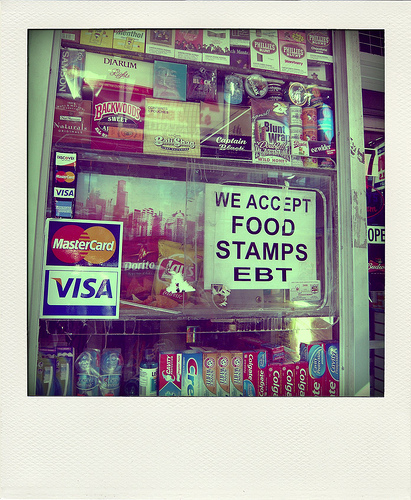
Thinking more about grocery transactions recently has also helped me notice where various food outlets are placed. I usually shop at small natural-foods stores, which are concentrated around the center of town where housing and businesses cater to those in the upper income levels. Head toward the outskirts of the city, and you won’t find those cozy shops stuffed with bulk foods, fresh veggies and organic cheese. In fact, even the large grocery chains start dropping off, and for every Albertson’s or Safeway you’ll find three or four Dari-Marts, 7-11s, or Circle-Ks, all variations on the convenience store theme. I notice them because the changeable-letter signs often advertise “We take EBT”. For what, though? Doritos, candy, soft drinks, maybe some milk, eggs or boxed mac-and-cheese. So if you live in one of those neighborhoods, and maybe you don’t have a car, or the ability to bus into town to visit another store, what are your options?
I’m not the first person to notice this phenomenon, and much has been said about the problem of “food deserts” in both rural and urban areas. One proposal that keeps coming up is to not allow the purchase of high-calorie, low-nutrition foods under SNAP. As it currently stands, you can buy pretty much any food item in the grocery or convenience store using your food benefits. The federal SNAP website details what does and does not apply as “food” under the program. Among the things that don’t count: Alcohol, personal care items, vitamins, and live animals (No buying a catfish to fatten up in your living room, sorry). Twinkies, Velveeta and Kool-Aid do count, although most people would probably agree that they have few nutritional differences from toothpaste. The problem is, as SNAP argues in a report, that there would simply be too much administration involved in fine-tuning the definition of “food” to exclude “junk food”. And you know that food processors would find ways around the law if they did, fortifying their products until they met the minimum nutritional requirements.
In the interest of balancing out the junk food eligible for purchase under SNAP, the USDA implemented a program in 2007 that allows farmers markets to accept food stamps. Of course, this doesn’t address the underlying issue of the cost of fresh, locally produced food, so, in some states, other organizations have stepped in to offer subsidies to low-income farmers market shoppers. Still, less than 0.01% of all federal SNAP dollars were spent at farmers markets last year.
Another little-known fact about SNAP is you can also use food benefits to buy seeds for your garden. It’s another nice thought, but one that probably hasn’t been very popular. A lot of the low-income kids I met through the Americorps job this summer hadn’t ever eaten a fresh tomato before. If their parents aren’t buying this kind of stuff, the chances are even lower than they’ll want to grow it themselves.
So SNAP isn’t doing much to improve the health of low-income people in this country, but it probably isn’t the root of the problem, either. Regardless of how you pay for it, cheap, processed, and unhealthy food will always be an option, and more so if you live in a low-income neighborhood. It would be senseless to force stores in these areas to carry fresh produce that would probably just rot in the coolers. There’s an underlying issue here that needs to be addressed: the cycle of poverty and poor diet. If people didn’t grow up eating something, they aren’t usually going to start eating it as adults, and since poverty tends to persists through generations, it also defines the dietary habits of a large segment of the population. So you can make good food affordable, but that doesn’t mean it will replace bad food pound for pound. There’s also the issue of convenience. After working a double shift, your average single mother will probably be more willing to microwave a hot pocket than chop a salad.
Can we ever take fresh, local fruit and vegetables out of the domain of the well-off and align American food values along the lines of apples, not apple pie? Sure. I forgot to mention the steady, free source of local and organic vegetables that I relied on through my summer and fall of being on SNAP: the farm where I worked. When growing food is part of what you do for a living, you’re guaranteed nothing but to eat fairly decently. In fact, for most of human history, people made their living as farmers, and poor folks like me lived off potatoes, greens, fresh eggs, and fruit from the trees. We grew it ourselves. The rich gorged on lard, sugar and beef, got fat, and died of heart disease. Now the tables have turned. Over 70% of Americans are overweight or obese, and I would bet that most of them are currently on or have been on food stamps.
What we need is re-education, and the beginnings of it already exist. The best example I can think of is Farm to School, which takes kids on field trips out of the classroom to farms and also brings fresh food to them in the cafeteria. There’s also the Women, Infants and Children (WIC) program, similar to SNAP except with much stricter rules about what can be purchased, and it’s only available to mothers with children under five. It also has a fairly decent website with nutrition information and cooking tips, although it gets a bit patronizing (“Did you know that fruits and vegetables are naturally low in calories?” No waaay...)
As for me, I look forward to one day having the financial freedom to put my toothpaste, beer and bananas on the same piece of plastic. Maybe the fact that I have successfully used food stamps without packing on a layer of winter fat says something, but I think the average person on SNAP has a lot more hurdles to jump than I on the way to healthy living. Let’s fix our food system first, the one that pushed high-calorie diets on low-income people, and maybe we can all eat a bit fresher.
Find a farmer's market that accepts SNAP or WIC here.
Showing posts with label food security. Show all posts
Wednesday, December 29, 2010
Tuesday, October 20, 2009
Summing it all up
I don't normally post other people's writing/research, but this piece is fairly straightforward, somewhat frightening and hopefully, inspiring. The source is CommonDreams.org, a great source for humanitarian and environmental news.
On World Food Day: Crunching the Numbers
by Roger Doiron
- 1: number of new kitchen gardens planted at the White House this year AP
- 1943: the last time food was grown at the White House White House
- 20 million: the number of new gardens planted in 1943 LA Times
- 40%: percentage of nation's produce coming from gardens in 1943 LA Times
- 7 million: estimated number of new food gardens planted in the US in 2009 NGA
- $2000: amount of savings possible per year from a 40' x 40' garden KGI
- 90%: percentage of fruit/vegetable varieties lost in the US the last 100 years CNN
- 3500: number of vegetable varieties owned by Monsanto Monsanto
- 18,467: number of new small farms counted in the last agricultural census USDA
- 4,685: number of farmers markets nationwide USDA
- 4,100: number of Wal-mart stores and clubs in the US Wal-mart
- 187,000 ft2 : average area of a Wal-mart superstore Wal-mart
- 60,112 ft2: average area of a farmers' market USDA
- 9.5 million: number of imported food shipments arriving in the US each year Huffington Post
- 226,377: number of establishments registered to export food to the US Huffington Post
- 200: number of on-site inspections of these establishments conducted by the FDA last year Huffington Post
- 76 million: number of people who fall ill each year due to food poisoning CDC
- 50 gallons: volume of sugared beverages consumed per person in the US each year LA Times
- 22,727: number of Olympic-sized swimming pools those beverages would fill Answers.com
- $15 billion: annual estimated revenue of a penny-per-ounce tax on soda LA Times
- $20.5 billion: Coca-Cola's gross profit in 2008 Coca-Cola
- 72 million: number of American adults considered obese CDC
- 33%: percentage of US children likely to develop obesity or Type 2 diabetes CDC
- 10-15 years: average number of years their lives will be shortened as a result CDC
- 57 years: average age of the American farmer USDA
- 25 days: average shelf-life of a Twinkie Snopes
- 350 parts per million: sustainable level of CO2 in atmosphere 350.org
- 390 parts per million: current level of CO2 in the atmosphere NOAA
- 31%: percentage of human-caused greenhouse gas emissions attributable to food and agriculture IPCC
- 2020: year by which many geologists feel the world will have reached "peak oil" production UK Research Centre
- 10 calories: average amount of fossil fuel energy required to produce 1 calorie of food energy in industrialized food systems Cornell
- 29,100 calories: estimated fossil fuel calories required to produce one order of Outback Steakhouse Aussie Cheese Fries Men's Health
- 1 billion: number of hungry people in the world in 2009 FAO
- 9.1 billion: projected world population in the year 2050 US Census
- 70%: percentage increase in global food production required to feed that projected population FAO
- 70%: percentage of world's fresh water used for agricultural purposes UNESCO
- 1.8 billion: number of people expected to experience "water scarcity" in the year 2025 UNEP
- 0: number of new, oil-rich, water-rich, fertile and inhabitable planets we are likely to discover in the next 40 years
- 1: number of people needed to make a positive difference in any of the above: you!
Roger Doiron is Founding Director of Kitchen Gardeners International, an IATP Food and Society Fellow, and, if you believe the folks at Huffington Post, one of the top Green Game Changers of 2009. After the heartbreaking sweep of the Red Sox Sunday, he recently changed his own game from baseball to football.
Labels:
America,
climate change,
food,
food safety,
food security,
gardens,
peak oil,
small farms
Wednesday, October 7, 2009
Blight Fright: Wheat’s precarious position in the food supply
Your average aspiring self-sufficient, food-conscious home or community will likely contain a few staple ingredients or food sources that are local and sustainably produced (or at least as close to sustainable as mere mortals can achieve). You’ve got your farmers-market veggies, free-range eggs, organic dairy products, perhaps even some meat from a local grower if you’re so (gastronomically and financially) inclined.
But there’s one key ingredient missing from this happy pie of wholesome foodery. In fact, you would be hard-pressed to make any sort of pie without it. It’s grain – more specifically, wheat. In most parts of the world, its production is still stuck in the industrial, grossly unsustainable way of doing things, which is unfortunate because it’s such a central part of the Western diet. Had any bread, shredded wheat, crackers, pasta, or doughnuts today? Then you’ll see my point – wheat is everywhere. And while it may not seem to be in short supply, any person on a low income will tell you that the price of all of the above items has risen sharply in the last year or so. That’s because wheat is facing some serious global problems – disease, drought and heightened demand – that is causing the price to skyrocket on the global commodity market.
Clearly, wheat is another example of a food staple that is vitally important to re-localize. Having grains nearby, in the hands of hundreds of small farmers (or better yet, individual consumers with backyard gardens), instead of under the lock and key of four or five global conglomerates, makes their availability a surer bet. Only problem is, if you’re trying to be a locavore, bread and wheat products are one area in which you’re likely to break the local-food diet on a regular basis. Farmers growing for a local market tend to stick to vegetables, meat and eggs. Because of the processing (grinding into flour and other products) needed, wheat and other grains have managed to stay centralized, distributed from regional mills.
Let’s follow a typical pound of flour from the field to your morning pancakes. Once the grain is harvested (whether that farm is organic or conventional) it goes to a regional collection point. In Oregon, for example, all the wheat grown by farmers in the Willamette Valley (the main agricultural part of the state) gets trucked up to temporary storage somewhere near Portland. From there, it goes onto containers headed for Asia. That’s right. For all the millions of acres of grain produced close to home, only a tiny percentage of it makes it to the state’s only commercial grain milling facility in Eugene, and an even smaller percentage is actually consumed in the state. So those pancakes you ate this morning were more likely to be made from grain from the Midwest than from close to home. Of course, there's no way to know for sure, thanks to centralized distribution.
Sounds crazy, you say? Sorry, it’s all economics. The lowest price can only be obtained by controlling the supply through a limited number of processing facilities and shipping it out to retailers as needed. Do you like your cheap box of pancake mix? Do you? Well, then don’t ask so many questions.
In the meantime, local-food advocates keep harping on the need to circumvent this consolidated system – which applies not only to wheat but also just about any food product you can think of – and reestablish direct producer-to-consumer relationships. But why? Put simply, it’s a matter of food security. This means two things: the safety of the food we actually consume, and our ability to obtain it in the first place.
Let’s go back to the bag of mix you used to make your pancakes. Contamination in centralized processing plants (which is what recently compromised the safety of peanuts), isn’t the only problem. Black stem rust, a fungus that attacks wheat plants, is a looming but under-reported threat to wheat harvests around the world. It’s been around a long time – probably as long as wheat has been domesticated – but modern-day strains have been bred to resist the fungus. Now, as if it’s starring in its own terrible sci-fi flick, it’s back – with a vengeance. The fungus has finally evolved the genetic upper hand to destroy previously immune plants. Scientists are calling the new strain Ug99, for the country, Uganda, where it has hit the hardest, leaving behind acre upon acre of ashen, inedible wheat. It seems to be getting more virulent as it progresses, and is so immediately devastating to crops that the US (who else?) once bred it as a biological weapon.
We shouldn't have bothered - Ug99 is wreaking havoc all on its own, causing famine and strife all over Africa and the Middle East. We're not hearing much about it now, but as soon as it spreads to developed countries, I imagine that we will hear more.
Ironically, even Norman Bourlag, the much-lauded father of the “green revolution” and industrial agriculture, had to admit that the Ug99 problem is an unintended side-effect of the way conventional agriculture seeks to extract the most production out of a given piece of land. According to this article in NewScientist:
Ug99 isn’t the only threat to the world’s food supply, either. Since the beginning of the year, farmers in Canada and the Midwest have noticed a sharp increase in cases of Fusarium head blight, another fungus that affects wheat, barley, oats, rye, corn and grasses used to feed livestock. This one is sneakier: it doesn’t destroy plants right away but makes their grain toxic to consume. That means any slip-up in our notoriously shaky food-safety inspection system could poison hundreds or thousands of innocent pancake-eaters.
The most frustrating part about all of this is that there’s not much the average consumer can do to voice his or her protest against the way wheat is grown and distributed. Sure, we can buy organic, but organic grain is no more resistant to the diseases bred by conventional agriculture than its chemically nurtured counterparts. And “big organic” uses centralized distribution systems that, like any centralized system, erase the connections between producer and consumer until it’s impossible to tell where any given bag of flour was grown.
Still, one thing organic growers can’t do is spray their fields down with fungicide at the slightest hint of black stem rust, which is what conventional growers will surely do. And there is one way to ensure both the supply and safety of your wheat: grow and mill it yourself. I’m not being facetious. It takes surprisingly little grain to feed a family (ten families can live off one measly acre, according to an anonymous informational signboard at the Port Alberni fair last month), and there are actually super-compact mills built today that you can squeeze under your kitchen sink. Unless you live next door to a giant commercial wheat farm, there’s little chance of any global wheat pandemics affecting your plants.
Unfortunately, I have no personal experience with wheat cultivation, so I won’t instruct you on it here (perhaps in a future blog!) Instead, I’ll post yet another recipe, one that I’ve become quite familiar with since becoming the designated baker of Collins Farm. I’ve been making bread practically since I could reach the kitchen counter, but only started making yeast-free bread this summer. It has a unique flavor and texture but a dedicated fan base at our farm market. I’m a bit conflicted about selling it since bread is so deliciously simple to make, so I’m hoping making the recipe public will make kitchen revolutionaries out of a few of you.
The most important step is to find some local flour. If you live in Oregon, the local grain I discussed above is sold under the name Bob’s Red Mill. You can probably also find local farmers that grow grains if you ask around (try Willamette Farm and Food Coalition’s directory) If you live in Port Alberni, find Wayne Smith at the Farmer’s Market at the Harbor Quay – he sources his own organic grain and grinds it up fresh. It’s incredible stuff.
Tuula’s Whole Grain Bread
Makes 2 loaves
To make from starter:
Starter takes about 48 hours to ferment, but it makes awesome bread and eliminates the need for yeast. I start in the morning two days before I want to make bread. Combine a cup of water and a cup of whole wheat flour in an airtight container. Keep it in a warm place where it won’t be disturbed (in the oven with the light on is good). The next morning, “feed” it by adding another cup of flour and another cup of water. It should be bubbly and smell “yeasty”. Set it aside again until you make your bread (that evening or the next morning). You can keep the starter going for as long as you like but it will turn into sourdough starter after about a week (you can find lots of instructionals online for making sourdough bread this way).
To make from yeast:
Use active dry yeast (not instant) or fresh yeast, which is available from bakeries.
In a large bowl, dissolve 2 tablespoons molasses or honey* in 2 cups lukewarm water (no hotter than 115 degrees). Sprinkle in 1 ½ tablespoons yeast and allow to sit for ten minutes, or until it looks bubbly.
*Molasses gives a nice dark color to the bread but some prefer the flavor of honey, so use both if you like.
Bread recipe
2 cups starter or 1 1/2 tablespoons yeast
1 ½ cups water (in addition to water used in yeast method)
2 tablespoons molasses or honey*
2 tablespoons oil (vegetable or olive work fine)
½ teaspoon salt
7 cups whole wheat flour
½ cup dry 7-grain cereal
½ cup cooked brown rice (or substitute more cereal)
½ cup any combination flax seeds, sunflower seeds and/or pumpkin seeds
1. Add 1 cup hot water to the 7-grain cereal, set aside to soak.
2. Prepare yeast mixture as above or pour starter into a large bowl. Add molasses (if using starter), oil, salt and 2 cups of the flour. Mix well (lumps are ok) and add soaked cereal, rice and seeds.
3. Continue adding flour until a dough forms. Turn onto a floured counter and knead for 10 minutes or until dough is smooth and elastic.
4. Place dough in a clean and oiled bowl, flip to coat both sides. Allow to rise two hours at room temperature or overnight in the refrigerator.
5. When dough has risen (it will not double in volume but perhaps get close depending on the strength of your yeast/starter), punch it down. Divide it into two loaves and place in bread pans or on baking sheets. Brush the loaves with a beaten egg and sprinkle on some extra seeds (this is optional but makes the loaves look prettier). Make a ½ inch deep cut lengthwise along the top of the loaf.
6. If dough was refrigerated, allow to rise an additional hour in the pans. If not, half an hour or so should do the trick. Again, the dough will not rise significantly but should grow a bit.
7. Bake at 375 for about an hour. Bread will brown on top and sound hollow when tapped. Allow to cool in pans for a few minutes, then turn onto racks to cool. Do not bag until completely cooled.
But there’s one key ingredient missing from this happy pie of wholesome foodery. In fact, you would be hard-pressed to make any sort of pie without it. It’s grain – more specifically, wheat. In most parts of the world, its production is still stuck in the industrial, grossly unsustainable way of doing things, which is unfortunate because it’s such a central part of the Western diet. Had any bread, shredded wheat, crackers, pasta, or doughnuts today? Then you’ll see my point – wheat is everywhere. And while it may not seem to be in short supply, any person on a low income will tell you that the price of all of the above items has risen sharply in the last year or so. That’s because wheat is facing some serious global problems – disease, drought and heightened demand – that is causing the price to skyrocket on the global commodity market.
Clearly, wheat is another example of a food staple that is vitally important to re-localize. Having grains nearby, in the hands of hundreds of small farmers (or better yet, individual consumers with backyard gardens), instead of under the lock and key of four or five global conglomerates, makes their availability a surer bet. Only problem is, if you’re trying to be a locavore, bread and wheat products are one area in which you’re likely to break the local-food diet on a regular basis. Farmers growing for a local market tend to stick to vegetables, meat and eggs. Because of the processing (grinding into flour and other products) needed, wheat and other grains have managed to stay centralized, distributed from regional mills.
Let’s follow a typical pound of flour from the field to your morning pancakes. Once the grain is harvested (whether that farm is organic or conventional) it goes to a regional collection point. In Oregon, for example, all the wheat grown by farmers in the Willamette Valley (the main agricultural part of the state) gets trucked up to temporary storage somewhere near Portland. From there, it goes onto containers headed for Asia. That’s right. For all the millions of acres of grain produced close to home, only a tiny percentage of it makes it to the state’s only commercial grain milling facility in Eugene, and an even smaller percentage is actually consumed in the state. So those pancakes you ate this morning were more likely to be made from grain from the Midwest than from close to home. Of course, there's no way to know for sure, thanks to centralized distribution.
Sounds crazy, you say? Sorry, it’s all economics. The lowest price can only be obtained by controlling the supply through a limited number of processing facilities and shipping it out to retailers as needed. Do you like your cheap box of pancake mix? Do you? Well, then don’t ask so many questions.
In the meantime, local-food advocates keep harping on the need to circumvent this consolidated system – which applies not only to wheat but also just about any food product you can think of – and reestablish direct producer-to-consumer relationships. But why? Put simply, it’s a matter of food security. This means two things: the safety of the food we actually consume, and our ability to obtain it in the first place.
Let’s go back to the bag of mix you used to make your pancakes. Contamination in centralized processing plants (which is what recently compromised the safety of peanuts), isn’t the only problem. Black stem rust, a fungus that attacks wheat plants, is a looming but under-reported threat to wheat harvests around the world. It’s been around a long time – probably as long as wheat has been domesticated – but modern-day strains have been bred to resist the fungus. Now, as if it’s starring in its own terrible sci-fi flick, it’s back – with a vengeance. The fungus has finally evolved the genetic upper hand to destroy previously immune plants. Scientists are calling the new strain Ug99, for the country, Uganda, where it has hit the hardest, leaving behind acre upon acre of ashen, inedible wheat. It seems to be getting more virulent as it progresses, and is so immediately devastating to crops that the US (who else?) once bred it as a biological weapon.
We shouldn't have bothered - Ug99 is wreaking havoc all on its own, causing famine and strife all over Africa and the Middle East. We're not hearing much about it now, but as soon as it spreads to developed countries, I imagine that we will hear more.
Ironically, even Norman Bourlag, the much-lauded father of the “green revolution” and industrial agriculture, had to admit that the Ug99 problem is an unintended side-effect of the way conventional agriculture seeks to extract the most production out of a given piece of land. According to this article in NewScientist:
Ug99 will find agriculture has changed to its liking in the decades stem rust has been away. "Forty years ago most wheat wasn't irrigated and heavily fertilised," says Borlaug. Now, thanks to the Green Revolution he helped bring about, it is. That means modern wheat fields are a damper, denser thicket of stems, where dew can linger till noon - just right for fungus.What Borlaug fails to mention is that not only do wheat plants grow closer together now than ever before, those plants are genetically identical thanks to hybridization. Farmers don’t save their own wheat for replanting, they buy it from a seed company (ie, Monsanto), which has developed wheat genetically programmed to produce the highest yield possible. So when a disease or fungus like Ug99 hits the genetic jackpot that allows it to destroy a wheat plant, it can destroy virtually all wheat plants, because there are only a few varieties grown in the world.
Ug99 isn’t the only threat to the world’s food supply, either. Since the beginning of the year, farmers in Canada and the Midwest have noticed a sharp increase in cases of Fusarium head blight, another fungus that affects wheat, barley, oats, rye, corn and grasses used to feed livestock. This one is sneakier: it doesn’t destroy plants right away but makes their grain toxic to consume. That means any slip-up in our notoriously shaky food-safety inspection system could poison hundreds or thousands of innocent pancake-eaters.
The most frustrating part about all of this is that there’s not much the average consumer can do to voice his or her protest against the way wheat is grown and distributed. Sure, we can buy organic, but organic grain is no more resistant to the diseases bred by conventional agriculture than its chemically nurtured counterparts. And “big organic” uses centralized distribution systems that, like any centralized system, erase the connections between producer and consumer until it’s impossible to tell where any given bag of flour was grown.
Still, one thing organic growers can’t do is spray their fields down with fungicide at the slightest hint of black stem rust, which is what conventional growers will surely do. And there is one way to ensure both the supply and safety of your wheat: grow and mill it yourself. I’m not being facetious. It takes surprisingly little grain to feed a family (ten families can live off one measly acre, according to an anonymous informational signboard at the Port Alberni fair last month), and there are actually super-compact mills built today that you can squeeze under your kitchen sink. Unless you live next door to a giant commercial wheat farm, there’s little chance of any global wheat pandemics affecting your plants.
Unfortunately, I have no personal experience with wheat cultivation, so I won’t instruct you on it here (perhaps in a future blog!) Instead, I’ll post yet another recipe, one that I’ve become quite familiar with since becoming the designated baker of Collins Farm. I’ve been making bread practically since I could reach the kitchen counter, but only started making yeast-free bread this summer. It has a unique flavor and texture but a dedicated fan base at our farm market. I’m a bit conflicted about selling it since bread is so deliciously simple to make, so I’m hoping making the recipe public will make kitchen revolutionaries out of a few of you.
The most important step is to find some local flour. If you live in Oregon, the local grain I discussed above is sold under the name Bob’s Red Mill. You can probably also find local farmers that grow grains if you ask around (try Willamette Farm and Food Coalition’s directory) If you live in Port Alberni, find Wayne Smith at the Farmer’s Market at the Harbor Quay – he sources his own organic grain and grinds it up fresh. It’s incredible stuff.
Tuula’s Whole Grain Bread
Makes 2 loaves
To make from starter:
Starter takes about 48 hours to ferment, but it makes awesome bread and eliminates the need for yeast. I start in the morning two days before I want to make bread. Combine a cup of water and a cup of whole wheat flour in an airtight container. Keep it in a warm place where it won’t be disturbed (in the oven with the light on is good). The next morning, “feed” it by adding another cup of flour and another cup of water. It should be bubbly and smell “yeasty”. Set it aside again until you make your bread (that evening or the next morning). You can keep the starter going for as long as you like but it will turn into sourdough starter after about a week (you can find lots of instructionals online for making sourdough bread this way).
To make from yeast:
Use active dry yeast (not instant) or fresh yeast, which is available from bakeries.
In a large bowl, dissolve 2 tablespoons molasses or honey* in 2 cups lukewarm water (no hotter than 115 degrees). Sprinkle in 1 ½ tablespoons yeast and allow to sit for ten minutes, or until it looks bubbly.
*Molasses gives a nice dark color to the bread but some prefer the flavor of honey, so use both if you like.
Bread recipe
2 cups starter or 1 1/2 tablespoons yeast
1 ½ cups water (in addition to water used in yeast method)
2 tablespoons molasses or honey*
2 tablespoons oil (vegetable or olive work fine)
½ teaspoon salt
7 cups whole wheat flour
½ cup dry 7-grain cereal
½ cup cooked brown rice (or substitute more cereal)
½ cup any combination flax seeds, sunflower seeds and/or pumpkin seeds
1. Add 1 cup hot water to the 7-grain cereal, set aside to soak.
2. Prepare yeast mixture as above or pour starter into a large bowl. Add molasses (if using starter), oil, salt and 2 cups of the flour. Mix well (lumps are ok) and add soaked cereal, rice and seeds.
3. Continue adding flour until a dough forms. Turn onto a floured counter and knead for 10 minutes or until dough is smooth and elastic.
4. Place dough in a clean and oiled bowl, flip to coat both sides. Allow to rise two hours at room temperature or overnight in the refrigerator.
5. When dough has risen (it will not double in volume but perhaps get close depending on the strength of your yeast/starter), punch it down. Divide it into two loaves and place in bread pans or on baking sheets. Brush the loaves with a beaten egg and sprinkle on some extra seeds (this is optional but makes the loaves look prettier). Make a ½ inch deep cut lengthwise along the top of the loaf.
6. If dough was refrigerated, allow to rise an additional hour in the pans. If not, half an hour or so should do the trick. Again, the dough will not rise significantly but should grow a bit.
7. Bake at 375 for about an hour. Bread will brown on top and sound hollow when tapped. Allow to cool in pans for a few minutes, then turn onto racks to cool. Do not bag until completely cooled.
Saturday, August 8, 2009
Planning for Eat-Ability
Imagine a setting in which people can live, access life's necessities without need for motorized transportation, and never worry about having adequate food or water. There are a thousand types of communities that might come to mind, but one of them is probably not a typical suburban or rural housing subdivision. Somehow, though, the majority of people in North America and other developed regions live in these kinds of developments. They sprawl like lichen on a rock across rural landscapes - without an outwardly visible source of food or water. Placed far from urban areas, with cul-de-sac after cul-de-sac of nearly identical houses and no other necessary amenities nearby, suburban and ex-urban (i.e., stuck in the middle of nowhere) developments are a prime example of bad design. They're impossible to walk through - most lack sidewalks or logical footpaths between cul-de-sacs. To access work, school, or stores, residents have no other option than to hop in their cars, get on the freeway, and find the nearest suburban center. The only remnants of nature might be found in the fake pond at the golf course or perhaps in the subdivision's name - "Willow Crest" or "Fox Hollow". And worst of all, most of these developments are built smack on top of prime farmland. From a food security perspective, this manner of paving over and occupying the landscape is fairly frightening.
Of course, some developers talk about "sustainable development" (a puzzling little oxymoron) or planning for "livability". They throw in a few bike paths and extra trees. Still, these greenwashing tactics don't solve the root problems of urban sprawl: isolation of communities and the destructin of ecologically valuable unpaved land that has the added benefit of keeping the population fed.
Thanks to rural land speculation and the cycle of decline in inner cities, this pattern of development has been difficult to stop or even slow, although the present recession is helping immensely. Still, the sight of sprawling asphalt and rows of single-family dwellings from an airplane window has the power to throw me into a funk of hopelessness for days.
But wait! Could there be a slow shift in consciousness here? I was recently mailed an article (the old-fashioned way, no less) describing the hottest trend in housing developments: organic farms. And I don't mean developers are buying out farmers and naming the subdivisions "Pesticide-Free Strawberry Fields" instead of "Shady Oak Glen". No, according the New York Times article, farms are now considered "subdivision amenities" by many developers. Instead of building homes around golf courses, they are putting in organic farms to draw in yuppie foodies or perhaps those who have ideas about living in a rural area. Residents can even pitch in around the farm and share in the harvest. Of course, the article left out some of the potential difficulties that immediately come to mind. What happens when the breeze shifts and some unfortunate homeowner realizes they've purchased the olfactory privilege of living downwind from the chicken house? Will residents tolerate the drone of a tractor disturbing the peaceful summer ambiance?
Apparently, somebody has figured out a way to make it work, because the developments do seem to have caught on. They probably won't work everywhere - not all sprawl takes place on pristine farmland with ample water - and they certainly don't cure the basic problems inherent in urban sprawl mentioned above, but I suppose if people must live in subdivisions, they might as well have a convenient, safe food source nearby. The logical next steps will be to put in a school, a few small, locally owned stores and restaurants, and public gathering spaces, eliminating the need to drive thirty minutes for a coffee fix or a new rake. Put it all together, and a sprawling city will have devolved into a cluster of small towns. Livability? Absolutely. Eat-ability? Even better.
Tuesday, May 26, 2009
Oregon Local Foods part 2: What’s for dinner?
Cassava root. Salmonberry. Black Republican cherries.
Never heard of them? There’s probably a reason for that – they are all edible plants native to the Willamette Valley here in Oregon. At one time, native Oregonians (from the Kalapooia and other tribes) ate cassava like we eat French fries today. Berry bushes in hundreds of varieties provided a wild harvest to anyone who knew how to tell a delicious snack from a bellyache. The black Republican cherry tree was introduced as a commercial crop in 1860, producing a plum-like fruit that was known throughout the Northwest.
Today, the cassava is protected as one of the few remaining indigenous plants in the area, our berry diet is limited to the two or three varieties that accompany peanut butter in sandwiches, and the words “black Republican” only bring to mind awful jokes.
But the irony is more immediate than that. Faced with a food culture that has been completely commodified, stripped of all regional identity and packed into neat little boxes (salmon burger, anyone?), chefs and food aficionados around the Willamette Valley are scratching wildly, looking for dishes that we can claim and incorporate into a distinctive local cuisine. I feel their pain – the lack of “American” food, leave alone Oregonian or Pacific Northwestern food is something I’ve long failed to understand. Once, a friend and I brainstormed an entire afternoon trying to think of something to cook for Saudi Arabian friends coming over for an authentic American dinner. We ended up making enchiladas. Close enough –as long as our guests never find their way south of the border.
It’s not that we don’t have material to work with in this region. Heirlooms like the black Republicans, including apple, pear and nut trees, as well as a varieties of beans, vegetables and berries, have been cultivated here since the first white settlers set up camp. The sense of local pride that has evolved around these crops is revealed in some of their names: Gramma Walters bean; Oregon Champion gooseberry. Because they are for one reason or another not commercially viable (delicate fruit, short shelf life, inconsistent production), many are in danger of extinction. Today, only a few, very old black Republican trees survive in the Eugene area and nowhere else, according to a book compiled by Gary Paul Nabhan, a well known ecologist and localization writer. The loss of heirloom varieties would be a blow to local agriculture, not just for cultural reasons but also because locally adapted crops tend to be hardier, better suited to the climate and soil conditions and thus less likely to need chemical inputs to thrive.
Anyway, anyone trying to establish a regional cuisine in Oregon has my full support, especially given some of the difficulties involved. Salmon is no longer an obvious choice for any of the Pacific Northwest. Gary Nabhan splits North America into distinct bioregions based on indigenous food traditions, and names this corner of the continent Salmon Nation. I support the idea behind this effort, but wish we could move beyond this beleaguered fish for its basis. One species is limited as a basis for an entire cuisine, and nobody with an ounce of ecological awareness would (or should) be caught dead eating anything but wild-caught salmon, whose numbers are swiftly dwindling anyway. In addition, any food trend that might eventually filter its way down to the masses (ie broke college students who find cooking an enjoyable form of productive procrastination) must be affordable, but most restaurants that attempt to differentiate their fare from that of Seattle or Portland tend to be in the price range of middle-aged urbanites with real jobs. In this economy, that leaves out roughly half of the population. (Really, though: the poverty rate in the Eugene area is higher than the state average, and Oregon is now has the second-highest unemployment rate in the nation.) Although the efforts of local chefs to get us to eat seasonally and locally with braised lamb in wild mushroom sauce are admirable, they aren’t the American’s South’s cornbread and grits. That is, you won’t see many of us switching from ramen-based diets anytime soon. As I mentioned in the previous post, the industrial food system has gotten most people used to food made from two or three major plants plus meat. It’s cheap and childishly easy to prepare (or pick up at the drive-thru window). Some serious re-education is in order before we can even think about preparing regionally based foods.
That said, I do see some adventurous farmers and blogger/cooks in the area making steps in these directions, first making the food available and then showing people that it’s not rocket science to put it together. Farmers near Corvallis are making serious efforts to reintroduce bean and grain production in the Willamette Valley; one Eugene-based blog has a recipe for black bean brownies. Is that the smell of synergy baking?
I’m not suggesting that Oregon farmers abandon all commodity crops for fields of waving cassava and garbanzos. After all, grass seed production generates $1.6 billion in economic activity in the state, and how else would every suburban home be able to cultivate an overwatered green monoculture without these farmers? Plus, other forms of agriculture are just way too much work, and since there simply aren’t enough illegal immigrants to go around, who will do it? On the other hand, small, organic farms have been shown to provide more ecosystem-like benefits while being more productive per acre than huge operations. And aren’t we facing something like a global food crisis? Wouldn’t it make more sense to give up just a few of those acres for diversified food production rooted in local traditions that we can all take pride in?
It’s all too confusing for me. I think I’ll just head to the kitchen to see if I can make black bean brownies that look as good as the picture on that blog. I only wish I had some black Republican cherry ice cream to put on top of them.
Never heard of them? There’s probably a reason for that – they are all edible plants native to the Willamette Valley here in Oregon. At one time, native Oregonians (from the Kalapooia and other tribes) ate cassava like we eat French fries today. Berry bushes in hundreds of varieties provided a wild harvest to anyone who knew how to tell a delicious snack from a bellyache. The black Republican cherry tree was introduced as a commercial crop in 1860, producing a plum-like fruit that was known throughout the Northwest.
Today, the cassava is protected as one of the few remaining indigenous plants in the area, our berry diet is limited to the two or three varieties that accompany peanut butter in sandwiches, and the words “black Republican” only bring to mind awful jokes.
But the irony is more immediate than that. Faced with a food culture that has been completely commodified, stripped of all regional identity and packed into neat little boxes (salmon burger, anyone?), chefs and food aficionados around the Willamette Valley are scratching wildly, looking for dishes that we can claim and incorporate into a distinctive local cuisine. I feel their pain – the lack of “American” food, leave alone Oregonian or Pacific Northwestern food is something I’ve long failed to understand. Once, a friend and I brainstormed an entire afternoon trying to think of something to cook for Saudi Arabian friends coming over for an authentic American dinner. We ended up making enchiladas. Close enough –as long as our guests never find their way south of the border.
It’s not that we don’t have material to work with in this region. Heirlooms like the black Republicans, including apple, pear and nut trees, as well as a varieties of beans, vegetables and berries, have been cultivated here since the first white settlers set up camp. The sense of local pride that has evolved around these crops is revealed in some of their names: Gramma Walters bean; Oregon Champion gooseberry. Because they are for one reason or another not commercially viable (delicate fruit, short shelf life, inconsistent production), many are in danger of extinction. Today, only a few, very old black Republican trees survive in the Eugene area and nowhere else, according to a book compiled by Gary Paul Nabhan, a well known ecologist and localization writer. The loss of heirloom varieties would be a blow to local agriculture, not just for cultural reasons but also because locally adapted crops tend to be hardier, better suited to the climate and soil conditions and thus less likely to need chemical inputs to thrive.
Anyway, anyone trying to establish a regional cuisine in Oregon has my full support, especially given some of the difficulties involved. Salmon is no longer an obvious choice for any of the Pacific Northwest. Gary Nabhan splits North America into distinct bioregions based on indigenous food traditions, and names this corner of the continent Salmon Nation. I support the idea behind this effort, but wish we could move beyond this beleaguered fish for its basis. One species is limited as a basis for an entire cuisine, and nobody with an ounce of ecological awareness would (or should) be caught dead eating anything but wild-caught salmon, whose numbers are swiftly dwindling anyway. In addition, any food trend that might eventually filter its way down to the masses (ie broke college students who find cooking an enjoyable form of productive procrastination) must be affordable, but most restaurants that attempt to differentiate their fare from that of Seattle or Portland tend to be in the price range of middle-aged urbanites with real jobs. In this economy, that leaves out roughly half of the population. (Really, though: the poverty rate in the Eugene area is higher than the state average, and Oregon is now has the second-highest unemployment rate in the nation.) Although the efforts of local chefs to get us to eat seasonally and locally with braised lamb in wild mushroom sauce are admirable, they aren’t the American’s South’s cornbread and grits. That is, you won’t see many of us switching from ramen-based diets anytime soon. As I mentioned in the previous post, the industrial food system has gotten most people used to food made from two or three major plants plus meat. It’s cheap and childishly easy to prepare (or pick up at the drive-thru window). Some serious re-education is in order before we can even think about preparing regionally based foods.
I’m not suggesting that Oregon farmers abandon all commodity crops for fields of waving cassava and garbanzos. After all, grass seed production generates $1.6 billion in economic activity in the state, and how else would every suburban home be able to cultivate an overwatered green monoculture without these farmers? Plus, other forms of agriculture are just way too much work, and since there simply aren’t enough illegal immigrants to go around, who will do it? On the other hand, small, organic farms have been shown to provide more ecosystem-like benefits while being more productive per acre than huge operations. And aren’t we facing something like a global food crisis? Wouldn’t it make more sense to give up just a few of those acres for diversified food production rooted in local traditions that we can all take pride in?
It’s all too confusing for me. I think I’ll just head to the kitchen to see if I can make black bean brownies that look as good as the picture on that blog. I only wish I had some black Republican cherry ice cream to put on top of them.
Saturday, February 7, 2009
Down with grass!
In the summer of 2008, farmer Harry MacCormack did something on his land that hasn’t been done in the Willamette Valley for over twenty years. In this small act, unbeknownst to most of his neighbors in nearby Corvallis , Oregon , he may have sparked a revolution that could transform the state’s economic structure and create a model for sustainable communities across the country.
So what was MacCormack up to on his farm last summer? He was growing beans. As food and fuel prices rise around the world and Oregon residents scramble for ways to reduce their demands on our fragile environment and economy, farmers are moving toward a solution that may seem simple in hindsight. Instead of devoting 80% of cropland acres to grass seed, an inedible crop of which very little actually stays in the region, farmers led by MacCormack are beginning a movement to use the valley’s fertile lands for growing food. Beans, grains, and other staples used to be primary crops in the region until suburban lawns and golf courses made grass seed a hot commodity. Today, this cash crop is as popular as ever, but increased problems with field burning and chemical use has farmers searching for alternatives.
MacCormack’s experimental planting, known by the coalition of farmers, distributors and retailers he works with as the “Bean and Grain Project,” could be the alternative. But the initiative is not without its detractors: some environmentalists say that attempting to grow certain crops in Oregon would require even more chemicals and energy than it would in their native environments. Many farmers simply cannot afford to switch from grass seed to less profitable crops. And eco-conscious as they may be, most food buyers in the region are used to the low prices allowed by importing beans and grains from countries where standards of living are lower.
Read more about the bean and grain project here: http://www.mudcitypress.com/beanandgrain.html
Monday, October 20, 2008
Food fights in Bangalore
[This post is from two weeks ago, when I set off for Bangalore for some travels in the area. Bangalore is the capital of Karnataka, home to at minimum 7 million people and growing. It also hosts number of NGOs and other groups working directly and indirectly on sustainable agriculture and development issues. My first stop is a two-day seminar on small-scale agriculture in the city itself.]
The journey from Sirsi to Bangalore – despite taking ten hours over bumpy roads – was actually quite comfortable thanks to the wonder of sleeper busses. Like sleeper cars in trains, these public transportation marvels feature narrow bunks surrounded by thick curtains, behind which the traveler may pass out for the duration of the trip. Within an hour of boarding, the financial news (which I have a sick fascination with, like a car accident) coming through my ipod lulled me into dreams of credit default swaps and naked short sellers.
The only unnerving part of the trip was the “rest stop” at 2 AM– most of the travelers were men, forcing me and my full bladder to dash across the darkened highway alone, flashlight in hand, to find a bush, all the time trying not to imagine the many ways I might die or, worse, miss the bus as it pulled away. In record time, I took care of business and climbed back into my bunk, none the worse for the wear.
When we reach Bangalore , it’s the tail end of a ten-day long holiday, so traffic isn’t bad. It’s raining, though, making the sight of the abject poverty – families living under tarps, mothers with young babies begging for change, streetside vendor after vendor selling the same unwanted wares – all the more depressing. It’s my first real encounter with a major Indian city, and the Malnad region where I work is by comparison very well off. I’ve come across probably two beggars in Sirsi. To the best of my ability, I put up a mental wall and worried instead about how I would locate Sunita in this enormous place.
Luckily, the conductor had assumed correctly that I would not recognize my stop name when he called it out, and jabs a finger in my direction when I am to get off. I stumble down the aisle with my overstuffed backpack and Sunita is waiting just outside, as promised (she’s already been here in Bangalore a couple of days). We get in the rick and zoom off to the NIAS campus.
On the way, Sunita explains that NIAS stands for the National Institute of Advanced Studies, one of the more prestigious universities in the country. It was actually founded by the same man who created the Tata empire, India ’s largest corporation. Tata is similar to GE in the states, with holdings in auto manufacturing, housing, media and just about anything else they can think of. The seminar Sunita and I are attending is entitled “Farmers, Livelihood and Trade” and is focused primarily on increasing the market share of small organic farmers. It’s actually being put on by GREEN (Genetic Resource Ecology Energy Nutrition) Foundation, one of the major agricultural NGOs in the area.
On arrival, we are given one of the guest rooms that NAIS has set aside for conferences such as these. In the walled-off campus with security guards at the gates, I can almost pretend I’m back in Sirsi. The biggest difference is nobody stares at me here – they’re all used to foreigners.
At the elaborate breakfast provided, I meet Dr. Vanaja Ramprasad, the surprisingly approachable and grandmotherly director of Green Foundation, who has been dedicated to improving the livelihoods of farmers for decades. An hour later (only half an hour behind schedule!) the conference kicks off with a lecture by Devinda Sharma, a journalist and expert on genetically modified crops and agro-politics. I’ve been given the intern’s honor of taking notes for the next two days, but I would have been riveted anyway: this guy is pretty incensed about the state of agriculture and India ’s farmers.
Most of Sharma’s talk relates to the WTO and its liberalization of international markets. Pre-WTO , India ’s GDP was 25% of the world total. It was a net exporter of food, meaning it shipped out more spices, grains and produce than it bought from other nations, and it didn’t rely on any of them to feed its population. 80% of Indians were employed in the agricultural sector.
Under the WTO, however, the balance began to shift. Heavily subsidized grains from the US began flooding the market, and all the nations who couldn’t compete were told to focus their agricultural production on exports to keep up.
The result was predictable. As Sharma put it, “Importing food is importing unemployment.” Today, India is headed down a path to attain a similar socioeconomic profile to the US, where less than 1% of the population (and dropping) grow agricultural products and a farmer living in Iowa would starve if his local grocery store suddenly ran out of supplies (due to, say, a fuel shortage) because he’s surrounded by a thousand miles of inedible corn and soybeans. The only difference is, there are simply too many people and not enough land for this system to work in India . Somewhere, something or somebody has to give, and I saw those somebodies outside my bus window on the way here. Most of those millions of homeless people are refugees from villages, where they’ve given up on the agricultural life because they can’t afford it (and because it doesn’t provide the glitzy lifestyle they’ve been watching on TV). People in the cities prefer cheap white rice and imported wheat, and crops grown for export must meet standards only attained through chemical inputs (large size, consistent color and texture, perfect skins). Farming using chemical fertilizers, pesticides and herbicides requires economies of scale unattainable by the average small land owner.
As Sharma and the other speakers at the seminar explained, organic farming is supposed to be the antidote to all this mess, but it lacks the government backing to really make it work. Commercial, “conventional” agriculture (using chemical inputs) is, of course, subsidized ever since the WTO arrived, which makes it very competitive in domestic and international markets. Organic farmers receive no such help. In fact, they have to pay for organic certification by often-sketchy certification boards, who in classic Indian style create a tangled network of bureaucratic procedures and paperwork. The farmers, on the other hand, are usually not the corporate-world dropouts who usually take up organic farming in the States. They’re simply trying to sell produce that has been grown the only way they’ve known how for centuries – without outside inputs and with minimal impact on the land.
Although I’ve been studying this stuff for a while, hearing it again and talking to the people who are running against these problems in real life left me feeling disheartened. The second day involved more group discussions with farmers and other interested parties, including one incident that was sort of the highlight for me: an organic farmers vs. biochemical company representative throwdown. This fellow actually had the gall to get up in front of the entire room of 100-some organic farmers and declare that organic food doesn’t taste as good as conventional. In true Indian fashion, he was quite straightforwardly told to shove it. We didn’t see him the rest of the conference.
Despite that happy episode, I left the conference feeling frustrated and a bit hopeless, not only because of what I’d heard, but also because of what I hadn’t heard – an actual solution or at least a plan. Sure, in our air-conditioned haven with meals provided every four hours, we’d come up with a list of “policy recommendations” for the Indian government. But after witnessing during the last few weeks the clumsiness of India ’s bureaucracy and the ease with which it is ignored by most citizens, I have my doubts that policy recommendations will have any impact at all. In fact, many of the policies we’d recommended – like setting up farmer-owned organic brands and providing subsidies to organic farmers – already exist, they just aren’t working. While it’s nice to have neat summations of the problems, their solutions, I suspect, are hiding somewhere else.
Next stop: Navadarshanam, a collective just outside Bangalore that’s too natural for organics, where I’ll learn how to find the best ants for eating and become part of the best International Team since the Special Olympics.
Subscribe to:
Posts (Atom)